Identity

Opprinnelig pris var: 198.00 kr.Nåværende pris er: 59.40 kr.

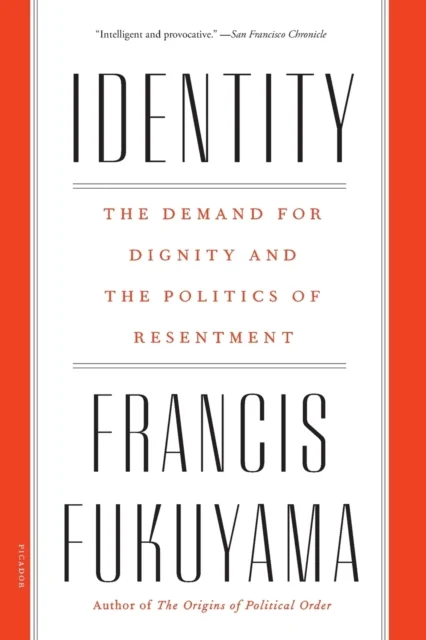
The New York Times bestselling author of The Origins of Political Order offers a provocative examination of modern identity politics: its origins, its effects, and what it means for domestic and international affairs of stateIn 2014, Francis Fukuyama wrote that American institutions were in decay, as the state was progressively captured by powerful interest groups. Two years later, his predictions were borne out by the rise to power of a series of political outsiders whose economic nationalism and authoritarian tendencies threatened to destabilize the entire international order. These populist nationalists seek direct charismatic connection to “the people,” who are usually…

Gå til kassen
SKU: TYRWXLI9190770788528
Category: ,

Beskrivelse

The New York Times bestselling author of The Origins of Political Order offers a provocative examination of modern identity politics: its origins, its effects, and what it means for domestic and international affairs of stateIn 2014, Francis Fukuyama wrote that American institutions were in decay, as the state was progressively captured by powerful interest groups. Two years later, his predictions were borne out by the rise to power of a series of political outsiders whose economic nationalism and authoritarian tendencies threatened to destabilize the entire international order. These populist nationalists seek direct charismatic connection to “the people,” who are usually defined in narrow identity terms that offer an irresistible call to an in-group and exclude large parts of the population as a whole. Demand for recognition of one’s identity is a master concept that unifies much of what is going on in world politics today. The universal recognition on which liberal democracy is based has been increasingly challenged by narrower forms of recognition based on nation, religion, sect, race, ethnicity, or gender, which have resulted in anti-immigrant populism, the upsurge of politicized Islam, the fractious “identity liberalism” of college campuses, and the emergence of white nationalism. Populist nationalism, said to be rooted in economic motivation, actually springs from the demand for recognition and therefore cannot simply be satisfied by economic means. The demand for identity cannot be transcended; we must begin to shape identity in a way that supports rather than undermines democracy.Identity is an urgent and necessary book—a sharp warning that unless we forge a universal understanding of human dignity, we will doom ourselves to continuing conflict.

Beskrivelse

Questions about who we are, who we can be, and who is like and unlike us underpin a vast range of contemporary social issues. What makes our families so important to us? What do the often stark differences between how we self-identify and the way others see and define us reveal about our social world? Why do we attach such significance to »being ourselves»?In this new edition of her popular and inviting introduction, Steph Lawler examines a range of important debates about identity. Taking a sociological perspective, she shows how identity is produced and embedded in social relationships, and worked out in the practice of people»s everyday lives. She challenges the perception of identity as belonging within the person, arguing instead that it is produced and negotiated between persons. Chapter-by-chapter her book explores topics such as the relationships between lives and life-stories, the continuing significance of kinship in the face of social change, and how taste works to define identity. In particular, the updated edition has a new chapter on identity politics, as well as carefully compiled guides for further reading that reflect the broad importance and impact of these ideas, and the fact that, without understanding identity, we can»t adequately begin to understand the social world. This book is essential reading for upper-level courses across the social sciences that focus on the compelling issues surrounding identity.

Relaterte produkter