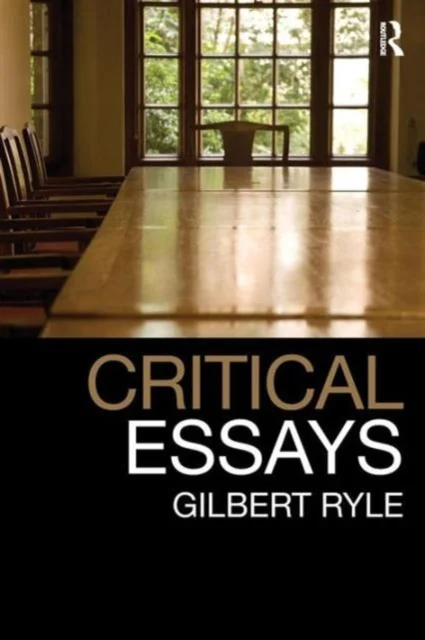
Critical Essays

Opprinnelig pris var: 719.00 kr.Nåværende pris er: 179.75 kr.

Gilbert Ryle was one of the most important and controversial philosophers of the Twentieth century. Long unavailable, Critical Essays: Collected Papers Volume 1 includes many of Ryle»s most important and thought-provoking papers. This volume contains 20 critical essays on the history of philosophy, with writing on Plato, Locke and Hume as well as important chapters on Russell and Wittgenstein. It also includes three essays on phenomenology, including Ryle»s famous review of Martin Heidegger»s Being and Time first published in 1928. Although Ryle believed phenomenology »will end in self-ruinous subjectivism or in a windy mysticism» his review also acknowledged that Heidegger…

Gå til kassen
SKU: MVFKGTQ1931470788226
Category: ,

Beskrivelse

Gilbert Ryle was one of the most important and controversial philosophers of the Twentieth century. Long unavailable, Critical Essays: Collected Papers Volume 1 includes many of Ryle»s most important and thought-provoking papers. This volume contains 20 critical essays on the history of philosophy, with writing on Plato, Locke and Hume as well as important chapters on Russell and Wittgenstein. It also includes three essays on phenomenology, including Ryle»s famous review of Martin Heidegger»s Being and Time first published in 1928. Although Ryle believed phenomenology »will end in self-ruinous subjectivism or in a windy mysticism» his review also acknowledged that Heidegger was a thinker of great originality and importance. While surveying the developments in the philosophy of language and philosophical logic, Ryle sets out his own conception of the philosophers» role against that of his predecessors and contemporaries.Together with the second volume of Ryle»s collected papers Collected Papers Volume 2 and the new edition of The Concept of Mind, all published by Routledge, these outstanding essays represent the very best of Ryle»s work. Each volume contains a substantial introduction by Julia Tanney, and both are essential reading for any student of twentieth-century philosophies of mind and language.Gilbert Ryle (1900 -1976) was Waynflete Professor of Metaphysics and Fellow of Magdalen College Oxford, an editor of Mind, and a president of the Aristotelian Society. Julia Tanney is Senior Lecturer at the University of Kent, and has held visiting positions at the University of Picardie and Paris-Sorbonne.
Beskrivelse

An introduction for English-language readers to Georges Bataille’s postwar philosophical and critical writings. In the aftermath of World War II, French thinker and writer Georges Bataille forged a singular path through the moral and political impasses of his age. In 1946, animated by “a need to live events in an increasingly conscious way,” and to reject any compartmentalization of intellectual life, Bataille founded the journal Critique. Continuing the publication of his postwar writings, this second book in a three-volume collection of Bataille’s work collects his essays and reviews from the years 1949 to 1951. In this period of intellectual isolation and intense reflection, Bataille developed and refined his genealogy of morality through a sustained reflection on the fate of the sacred in the modern world. He offered a critique of the limits of existing morality, especially in its denial of excess, while sketching the lineaments of a new hyper-morality. Bataille’s wide-ranging reflections are true to the intellectual mission of Critique, which he founded as a space open to the broadest considerations of the present. As well as discussing significant figures like Samuel Beckett, André Gide, and René Char, Bataille also offers fascinating reflections on American politics, Nazism, existentialism, materialism, and play. The connecting thread in these diverse essays remains Bataille’s concern with the extremes of human experience and the possibilities of transcending the limits of societies founded on utility and restraint. His writings remain a provocative incitement to rethink the boundaries we impose on expression and existence.

Relaterte produkter