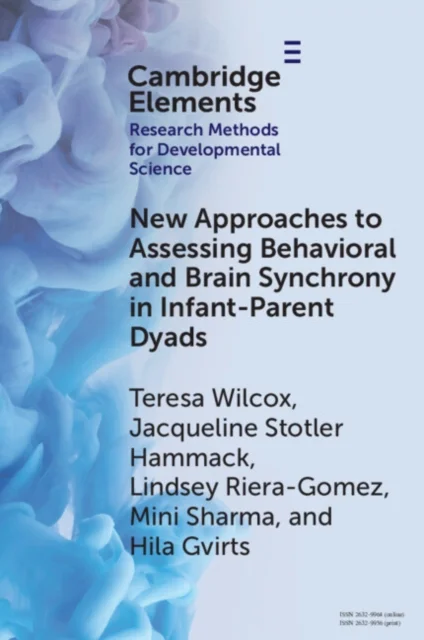
New Approaches to Assessing Behavioral and Brain Synchrony in Infant-Parent Dyads

Opprinnelig pris var: 269.00 kr.Nåværende pris er: 80.70 kr.

Historically, infant–parent synchrony has been measured using methods that provide a global assessment of interpersonal synchrony, representing the quality of dyadic interactions. These approaches have illuminated much about synchrony as a broad construct but lack granular details on the temporal dynamics of these interactions. This Element introduces technologically advanced methods for assessing brain and behavior that can offer detailed insights into the dynamic temporal structure of infant–parent social exchanges. These advancements will significantly enhance our understanding of the bidirectional processes that underpin early emerging dyadic exchanges and how these vary across time and context.


Gå til kassen
SKU: WCUCQHB6000670788685
Category:

Beskrivelse

Historically, infant–parent synchrony has been measured using methods that provide a global assessment of interpersonal synchrony, representing the quality of dyadic interactions. These approaches have illuminated much about synchrony as a broad construct but lack granular details on the temporal dynamics of these interactions. This Element introduces technologically advanced methods for assessing brain and behavior that can offer detailed insights into the dynamic temporal structure of infant–parent social exchanges. These advancements will significantly enhance our understanding of the bidirectional processes that underpin early emerging dyadic exchanges and how these vary across time and context.

Beskrivelse

Historically, infant–parent synchrony has been measured using methods that provide a global assessment of interpersonal synchrony, representing the quality of dyadic interactions. These approaches have illuminated much about synchrony as a broad construct but lack granular details on the temporal dynamics of these interactions. This Element introduces technologically advanced methods for assessing brain and behavior that can offer detailed insights into the dynamic temporal structure of infant–parent social exchanges. These advancements will significantly enhance our understanding of the bidirectional processes that underpin early emerging dyadic exchanges and how these vary across time and context.

Relaterte produkter